
If you work in the financial industry, corporate finance, or investment banking, you have probably asked yourself: Is equity value the same as market cap?
The short answer is yes. In the finance industry, equity value and market cap are generally the same thing. They hold the same core meaning, use the same basic formula, and are often used interchangeably on a case-by-case basis depending on the situation.
Whether you call it market cap or equity value usually just depends on the specific industry sub-sector you are working in or the person you are talking to. However, to truly master financial modeling and analysis, it is important to understand exactly how these metrics work, how they differ from accounting book value, and how to calculate them.
What is Market Cap?
Market capitalization (or market cap) is one of the easiest and most common formulas you will learn in finance. It represents the total value of a company’s equity as determined by the stock market.
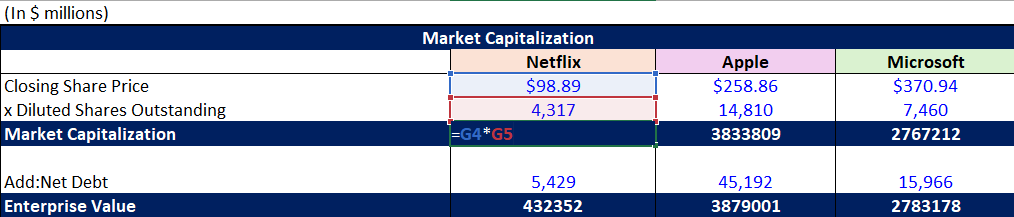
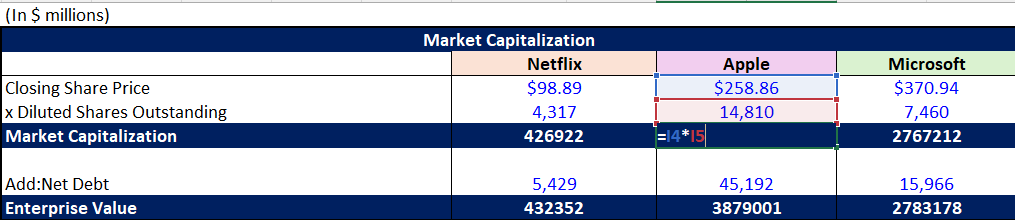
You calculate it by multiplying the latest closing share price by the total diluted shares outstanding. You can find the latest share price on any standard financial portal, and you can pull the exact diluted shares outstanding from the company’s latest filings (like the 10-Q or 10-K).
Market Cap Formula: Market Cap = Latest Closing Share Price × Total Diluted Shares Outstanding
A Simple Example: Let’s say a company has a share price of $1.00 and has 10,000 diluted shares outstanding.
- Market Cap = $1.00 × 10,000
- Market Cap = $10,000
Why Market Cap Matters
Market cap is a vital metric for anyone in corporate finance, buy-side/sell-side equity research, or portfolio management. It tells you exactly how big a company is and how investors currently value the business.
It is widely used for stock analysis, portfolio allocation, and peer comparison. For instance, if you are analyzing the tech sector, comparing the market caps of different tech companies immediately shows you their relative size, true market value, and growth potential.
What is Equity Value?
As mentioned, Equity Value is essentially the current market value of a company’s equity—making it the exact same thing as market capitalization.
However, a very common point of confusion is the difference between the Market Value of Equity (Market Cap) and the Shareholders’ Equity found on a company’s balance sheet.
Equity Value (Market Cap): Calculated by multiplying the current share price by total diluted shares. It reflects current market sentiment and future growth expectations.
Shareholders’ Equity (Book Value): An accounting metric found on the balance sheet. It is based strictly on historical data.
Equity Value vs. Book Value
Here is a quick breakdown to help you compare the two:
| Feature | Equity Value (Market Cap) | Shareholders’ Equity (Book Value) |
| Source | The Stock Market | The Balance Sheet (10-Q / 10-K) |
| Basis of Valuation | Future expectations & growth | Historical accounting data |
| Market Sentiment | High (driven by investor sentiment) | None (strictly accounting) |
| Calculation | Share Price × Diluted Shares | Total Assets – Total Liabilities |
Alternative Formula for Shareholders’ Equity: Shareholders’ Equity = Share Capital + Retained Earnings + Reserves
Example (XYZ Company): Let’s say Company XYZ has a share price of $200 and 10,000 shares outstanding.
- Equity Value = $200 × 10,000 = $2,000,000
Now, if we look at Company XYZ’s 10-K, we see Total Assets of $300 million and Total Liabilities of $200 million.
- Shareholders’ Equity = $300M – $200M = $100 million
Both metrics are incredibly important to investors, but they serve completely different technical perspectives.
Real-Life Case Study: Netflix, Apple, and Microsoft
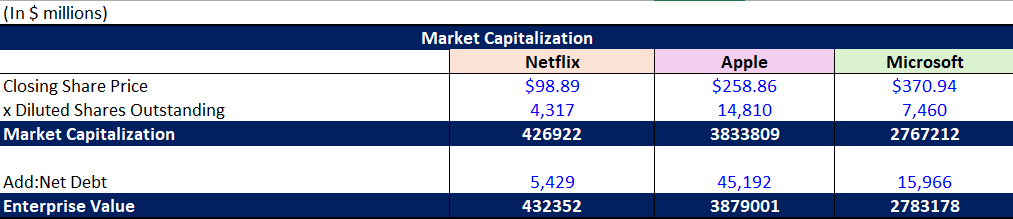
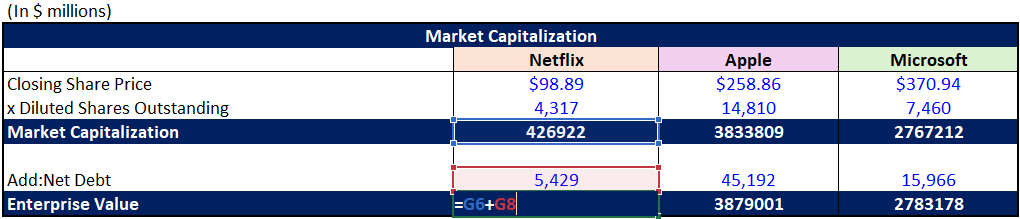
Let’s look at a real-world scenario using data from April 2026. We will calculate the market cap and Enterprise Value (EV) for three mega-cap tech giants.
(Note: Share prices are in dollars; Shares, Market Cap, Debt, and EV are represented in millions).
1. Netflix (NFLX)
- Closing Share Price: $98.89
- Diluted Shares Outstanding: 4,317
- Calculated Market Cap: $426,922
- Net Debt: $5,429
- Enterprise Value: $432,352
2. Apple (AAPL)
- Closing Share Price: $258.86
- Diluted Shares Outstanding: 14,810
- Calculated Market Cap: $3,833,809
- Net Debt: $45,192
- Enterprise Value: $3,879,001
3. Microsoft (MSFT)
- Closing Share Price: $370.94
- Diluted Shares Outstanding: 7,460
- Calculated Market Cap: $2,767,212
- Net Debt: $15,966
- Enterprise Value: $2,783,178
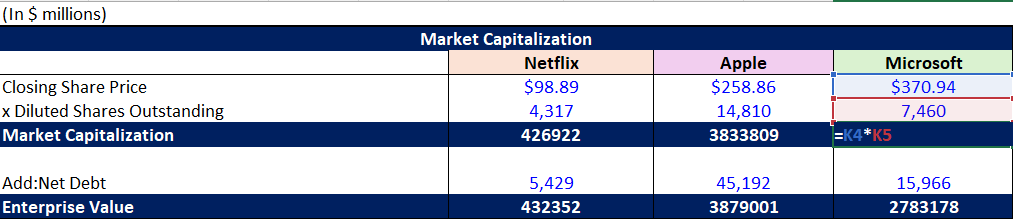
These three companies are considered “Mega Cap” stocks because of their massive valuations and dominant market share in the tech industry.
Get your free template here. Simply input your numbers to automatically determine the Equity Value and Enterprise Value.
Bridging Market Cap to Enterprise Value
In the case study above, we calculated Enterprise Value. If you know a company’s market cap, getting to Enterprise Value is simple:
Enterprise Value Formula: Enterprise Value = Market Capitalization + Net Debt
How to calculate Net Debt: You find Net Debt by taking the company’s short-term borrowings plus long-term debt, and then deducting cash, cash equivalents, and short-term investments (like marketable securities).
If you already have the Enterprise Value and want to work backward to find the Market Cap (Equity Value), you simply deduct the Net Debt from the Enterprise Value.
The Standard Market Cap Categories
When filtering or screening stocks, the financial industry categorizes companies into different tiers based on their market capitalization. Here is the standard breakdown:
- Mega Cap: $200 billion and above
- Large Cap: $10 billion to $200 billion
- Mid Cap: $2 billion to $10 billion
- Small Cap: $300 million to $2 billion
- Micro Cap: Under $300 million
Conclusion
Ultimately, there is hardly any difference between Equity Value and Market Cap. They are the same concept, used interchangeably depending on who you are talking to and the specific financial context.
To make this easier for your own analysis, you can download my free Excel template . This file includes everything you need to automatically calculate Market Cap, and Enterprise Value.
The tutorials, resources, financial models, and Excel templates provided by Finance With Logic are strictly for educational and informational purposes. They do not constitute professional financial, legal, tax, or investment advice. Financial forecasting involves inherent risks and assumptions. Please consult with a certified financial advisor, CPA, or registered broker before making any real-world investment decisions, executing trades, or finalizing corporate capital allocations based on these materials. Use of these models is at your own risk.
FAQ
The short answer is yes. In the finance industry, equity value and market cap are generally the same thing. They hold the same core meaning, use the same basic formula, and are often used interchangeably on a case-by-case basis depending on the situation.
You calculate market cap by multiplying the latest closing share price by the total diluted shares outstanding.
Market Cap = Latest Closing Share Price × Total Diluted Shares Outstanding
Yes, they hold the same meaning. They have same formula but are often used interchangeably in financial industry.
You need to add net debt to equity value to calculate enterprise value.
Enterprise Value = Market Capitalization + Net Debt
No, shareholder’s equity and market value of equity are not the same thing.
Shareholder’s Equity: An accounting metric found on the balance sheet. It is based strictly on historical data.
Market Cap = Latest Closing Share Price × Total Diluted Shares Outstanding










Leave a Reply